Sunday, June 28, 2020

Inquiry

Sedimentary Rocks

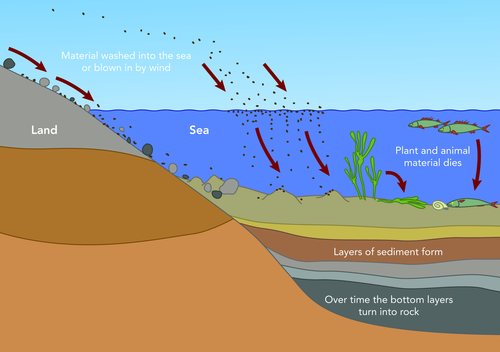
Sedimentary rocks are formed from broken down bits of other rocks or even from the remains
of plants or animals. The little pieces collect in low-lying areas by lakes, oceans, and deserts.
They are then pressed into rock by the weight of the materials around them and on top of them.
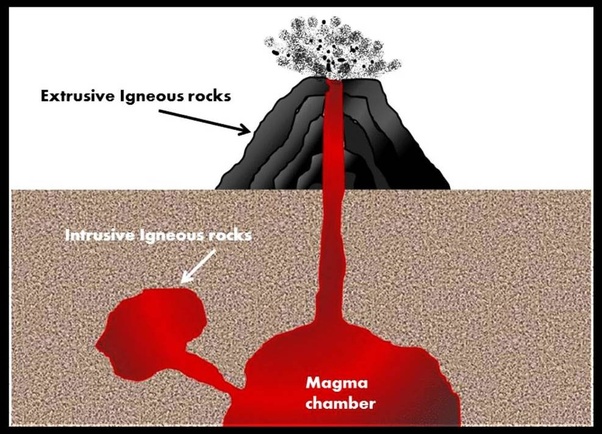
Image result for layers of sediment diagram


Metamorphic Rocks
Metamorphic rocks are formed when sedimentary or igneous rocks are affected by great
temperatures and pressures. They do not melt, but the chemicals they contain may change
their crystal shapes. The name metamorphic comes from Greek words meaning “change
of shape.”If there is a serious amount of pressure or heat, these stones undergo
metamorphosis, harden and create new crystals! This happens over time, and isn’t instant.
That’s pretty interesting.


Examples of metamorphic rocks include anthracite, quartzite, marble, slate, granulite,
gneiss and schist.

Image result for metamorphic rock diagram

Igneous Rocks
Igneous rocks are rocks that have formed by the cooling and hardening of molten lava or
magma. When magma comes out onto the surface of the Earth, it is called lava.
Lava cools down to form rocks such as tuff and basalt (extrusive rocks).
Also, the magma may slowly cool down to form rocks under the surface (intrusive rocks).
An example is granite.

Igneous rock is formed in two ways.

  • Igneous rock formed from magma that has become solid inside the earth is called intrusive igneous rock. Intrusive igneous rock cools slowly because it is inside the earth. Examples of intrusive igneous rock types are gabbro, diorite, and granite.
  • Igneous rock formed from lava that has become solid on the outside of the Earth is called extrusive igneous rock. This can happen because of the eruption of a volcano. Extrusive igneous rock cools quickly. Some extrusive igneous rock types are basalt, andesite, rhyolite, tuff, obsidian, and pumice.
Image result for igneous rock diagram
Volcanos
There are three main types of volcano in New Zealand:
  • cone volcanoes (like Mt Taranaki)
  • caldera volcanoes (like Taupo)
  • volcanic fields (like Rangitoto)
Here is a link to the GNS website with more information.


Earth's Crust


Saturday, June 27, 2020

Final Week of Term 2!

Kia Ora All,

Welcome to the final week of term two! It's been a great term, albeit it shorter than expected at the start of the year. Here are a couple of things to be aware of.

  • Every term I run a BTB points auction. Over the term the students build up a bank of BTB points awarded for good behaviour, outstanding manners, great sportspersonship, excellent work habits and superb effort in their learning. At the end of the term the students use their points to bid for items which have been donated to the auction. I've asked students to bring in small items they no longer want to donate to the auction e.g., old toys, stationary items, books etc. Anything small and inexpensive is fine. The more items donated, the more fun the auction is. At this point, the auction is scheduled for Friday. 
  • The Room 2 class camp will be a city experience in Nelson this year (as was originally planned, but I’ve managed to re-book the camp post lockdown). We’ll be heading over the hill on Wednesday the 2nd of September and coming back on Friday the 4th - this is week 7 of Term 3. We’ll be staying at the Nelson City Top 10. Cooking will be done on site in the kitchens at the campground. The fundraising committee is covering half the cost of this camp, so the billed total will be $85 per child. I’ll send out a finalised itinerary closer to the time as well as requests for camp parent volunteers. But for now, just pop this date in your diary and feel free to let me know if you’re planning to come.
  • Homework books / times tables cards etc on Monday please!
Rock On,
Mr M

Saturday, June 20, 2020

Welcome to Week 8

Kia Ora All,

The mighty Room Two have continued to heroically soldier on through their learning odyssey. Last Friday, we started back with our geology inquiry topic, which was postponed due to lockdown, and began looking at volcanoes in Aotearoa. First we talked about the three main types of volcano found here. Then we looked at some examples, found them on Google Maps and marked them in on a map of NZ which was glued into our inquiry book. We've also been talking about volcano vocabulary. If you want to know what a pyroclastic flow is, feel free to ask someone from Room Two. 
  • Parent tchr interviews are in the final week of term. If you haven't booked in yet, now is a good time to lock in a interview.
  • The year 2 - 4 students will be going to the Mini Outdoor Adventure Programme at Whenua Iti Outdoor Education Centre in Lower Moutere on Thursday the 20th of August.
  • On Friday, almost all the kids were tested on their times tables. Friday is tables day and Monday is spelling day. Please make sure tables cards and homework book is in your child's book bag and ready for school on Monday.
  • I'm trying to get the students back into the rhythm of completing their set Maths Buddy tasks weekly. I set four tasks each week and aim to check every Sunday to see how students have got on. I'm going to have a Maths Buddy points chart to celebrate kids who finish all their tasks. Completing tasks is in no way related to maths ability as I set appropriate tasks for each group or individual as necessary. Only one student completed all their tasks last week so I've extended the tasks for a few days. Students have time in class to complete tasks. It's also a good homework task for those who are interested in adding some maths into their home learning programme.
Rock On,
Mr M

Saturday, June 6, 2020

Week Seven Update

Kia Ora All,

Here's the week 7 update:

  • Homework books on Monday please.
  • Book bags on Monday please.
  • Times Table flashcards on Monday please.
  • Here are some pictures of students working on their writing and also a geography task last week.
  • Enjoy the sunny arvo. 

Rock On,
Mr M


Sunday, May 31, 2020

What's Coming Up?

Kia Ora All,

I hope everyone has had an excellent long weekend. We're heading into the third week back at school. I'm thoroughly looking forward to getting into it.

  • Homework books / book bags / times table cards on Monday please.
  • Friday is library day. 
  • Times tables were checked on Friday. Students have time within class to work on them but it's also a perfect home learning task too. Working on times tables regularly in short bursts is the best idea.
Rock On,
Mr M

Below are some pictures of the students in action on Friday creating their abstract art masterpeices inspired by Russian artist Sonia Delaunay.


Saturday, May 23, 2020

The First Week Back At School

Kia Ora All,

Room two has gotten off to a great start this term. We've been working on getting back into routine and the students have slotted in well. We're welcoming Oakie, Tessa and Jett who have moved into our class from Room 3, and farewelling Quinn, Finn and Que who have moved to Room One. In writing we're getting into persuasive texts. This week we've started planning and drafting a letter to Chris Hipkins about why schools need trees. In maths we've been working on open ended maths questions where the students get to 'play' with maths. Give this example problem a go: Two fifths of the students borrow books from the school library each day. How many kids might there be in the school and how many books did they borrow each day? We've also rounded out the week by starting a piece of abstract art inspired by Russian artist Sonia Delaunay. 

General Information

  • I checked book bags on Friday and so far as I know everyone now has one. Please check with your child to make sure they've got their homework book and times table flashcards in their book bag ready for Monday.
  • I'll endeavour to start homework for the term on Monday.
  • We're doing a times table push at the moment. For home learning you could help your child memorise their flashcards and make links between multiplication and division. Check out this blog post if you're unclear about how the flashcards work and watch the video called Times Tables Practice.


Rock On,
Mr M


Monday, May 11, 2020

The Final Week of Homeschool

Kia Ora All,

School starts back on Monday the 18th so this is the final week of homeschool. I've thoroughly enjoyed working with you all and getting updates about what you and your children have been up to. It's been very inspiring seeing the effort that's gone into home learning over the last six or seven weeks. It has been an excellent opportunity to work closely with students and whanau. I've especially enjoyed seeing the family effort that's gone into supporting students with Zoom sessions, recipe creation, student driven learning, and some very creative and impressive projects. I think you've all done a fantastic job, so make sure you schedule time to treat yourselves to a cup of tea and a lie down.

This week I'll send out some work, but I'm also planning work for the upcoming term so I'll have to simplify slightly.

  • Wednesday at 11.00am is the final Zoom session as I'll be setting up the classroom on Friday. 
  • Maths Buddy tasks are set. I suggest trying to knock a few off this week.
  • When we get back to school, I'm planning on getting into some serious times table learning. Reviewing this post and making some times tables flash cards would give your child a good boost if you haven't been working on them. 
  • Write a creative story using this story starter: My cousin can talk to goldfish. A great way to change up how you write a story is to set a timer. See how much you can write in 10 minutes. 
  • Give the below time problems a crack.
  • This DOC resource for learning about 10 native birds is very cool. 
Rock On,
Mr M


Time Problems

  • Mr M went swimming at 4 o’clock and got out of the pool at half past five. How long did he swim for?
  • If it takes half an hour to walk to school from home, how long will it take to walk to school and back home again?
  • Mrs Cullen had an appointment at the dentist at quarter past three. She didn’t arrive until 4 o’clock. How late was she?
  • The movie started at 6 o’clock and finished at quarter to eight. What was the running time of the movie?
  • Bodhi went to bed at 8 o’clock and woke up 11 hours later. What time did he wake up?
  • Muffins take half an hour to cook. If a batch of muffins goes into the oven at half past five what time will they be ready?
  • Amelie went to play netball at 4.00 and came home at 5.45. How long was she away?
  • If it takes 30 minutes to walk to the beach from home, how long will it take to walk to the beach and back home again?
  • Jodie had an appointment at 2.35. She didn’t arrive until 3.00. How late was she?
  • Hine’s TV programme started at 7.00 and finished at 8.45. How long was the programme?
  • Mr Cullen went to his grandma’s at 2.15 and stayed there for 6 hours. What time did he leave?
  • Potatoes take 25 minutes to boil. If Layla wants the potatoes to be ready by 5.30, when must she put them in the boiling water?

Sunday, May 10, 2020

Geography 101


  1. Which country has the biggest land mass?
  2. What is the capital city of Australia?
  3. Which two countries does the United States share a boarder with?
  4. What is another common name for the United States? (hint it's 3 letters)
  5. What South American country is this?:  _ r _ z _ l
  6. If you are standing in Greenland and you go to the nearest country to the south east, where would you be?
  7. Name two countries in Africa starting with 'Z'.
  8. Which country is between India and China?
  9. Alaska is beside Canada. Which country is to Alaska's west?
  10. What is the capital city of Iran 
  11. Name a country that Iran shares a boarder with.


Wednesday, May 6, 2020

Sharing work and pictures this week.

DIRECTIONS FROM HOME TO SPAIN
By Dayananda


Drive from home west to Golden Bay airport. 
Fly east to Wellington in the North Island.
Catch a boat and travel northwest to Sydney, Australia. 
Fly west to Perth and stay for a night. 
Then catch a boat north to Indonesia and travel up north
and west along the coast to India. 
Then take a train west/northwest to Iran. 
Get a car and drive west from Iran to Turkey. 
Then drive to the Mediterranean Sea coastline and
take a boat west across the sea to Spain. 

Arrived!


Finn's Picasso Study
Cody's Picasso Art
 Heidi's's Picasso Art
Amelie's continued PhD in Natural Disasters

Bodhi has been paddle boarding and kayaking, swimming with his dog Lola, doing his zoom lessons and riding his motor cross bike with his big brothers, Connor and Jamie. 

Olive's Directions to Spain

Drive south-east to Nelson Airport.
Fly north-west to Queensland, Australia.
Catch a boat north-west to Hong Kong.
Drive north-west to Moscow in Russia.
Catch a boat across the Black Sea going south to
Ankara in Turkey.
Go south-west to Antalya to visit Olive’s Grandma.
Catch a boat south to Cario in Egypt.
Fly west to Zaragoza in Spain. 
You have arrived!!!


Crack the code

01001, 11011, 01100, 01001, 01011, 00101, 11011, 01100, 01111, 01100, 01100, 01001, 00101, 10011

This code was written by

00100, 00001, 11001, 00001, 01110, 00001, 01110, 00100, 00001

Tuesday, May 5, 2020

Bodhi's Secret Message

Crack the code and write your answer in the comment section. Best of luck!

01001, 11011, 01100, 01001, 01011, 00101, 11011, 01000, 10101, 01110, 10100, 01001, 01110, 00111

Monday, May 4, 2020

Binary Digit Lesson

Computers use digits to represent information - this is why we talk about computers as being digital. Computers represent digits using binary numbers. Binary numbers can either be off or on. A computer’s processor is an electrical circuit; it consists of billions of transistors. A transistor is a tiny switch which is activated by the electronic signal it receives. Each binary digit is called a bit. The word comes from the ‘bi’ in binary and ‘t’ in digit. Eight bits make up a byte. That’s why the size of a computer’s memory is described in gigabytes.


Task One
Copy and complete this table:

8 = _ _ _ _ _
? = 11010
23 = _ _ _ _ _
19 = _ _ _ _ _
? = 10001
? = 00111
31 = _ _ _ _ _
? = 00100
14 = _ _ _ _ _
? = 00011


Task Two
Write your name using binary digits using the table below

A = 1
B = 2
C = 3
D = 4
E = 5
F = 6
G = 7
H = 8
I = 9
J = 10
K = 11
L = 12 
M = 13
N = 14
O = 15
P = 16
Q = 17
R =  18
S = 19
T =  20
U = 21
V = 22
W = 23
X = 24
Y = 25
Z = 26 
Space = 27


Task Three
Crack the code to read the secret message
10010, 01111, 00011, 01011, 11011, 01111, 01110

Task Four
Create your own message using binary digits and send it to me. I'll post it up for other kids to try to crack.

Rock On,
Mr M


Sunday, May 3, 2020

Design a Town

Draw a map of a town. Make it high quality and in colour. Street maps are always drawn as if you are looking straight down from above the town. Read the instructions carefully because there is a lot of detail that you need to pay attention to. Get an adult to check your map to make sure everything is in the right place before colouring it in. This activity is best done on A3 paper if you have it.
  • The library is north-east of the football ground.
  • The church is south-east of the library.
  • The school is south of the football ground.
  • The main road runs east/west.
You may include as many other landmarks / houses as you like so long as your map doesn't get too crowded. 

Rock On.
Mr M


Art History

Kia Ora All,

This week, for a change of pace, we're going to be studying one of the most famous artists ever: Picasso.

Watch this short video and answer the following questions:
History Questions 
  • Where was Picasso born?
  • What year was Picasso born in?
  • How many years ago was that?
  • Why did Picasso have a good start with becoming an artist?
  • In 1937 what happened in Spain?
  • How did Picasso feel about the thing that happened and what did he do?
  • What happened two years later in 1939?
  • Name the three periods that Picasso's work went through mentioned in the video.

Geography
You will need a world map, atlas or Google maps
  • Locate Spain on a map - what is Spain's capital city?
  • What are 3 countries to the north of Spain?
  • What is the sea to the east of Spain called?
  • What is the ocean to the west of Spain called?

With Parent Help Questions
  • What is a continent? 
  • Spain is part of a continent called Europe. Name 3 countries on a different continent.  
  • Is New Zealand a continent? Why or why not?

Extra for Experts
  • Write directions for how to get from your house to Spain. 
Here is a story about Picasso for you to enjoy.

Art
We're going to have a go at creating a cubist style portrait. Watch the video below and give it a crack. I'm looking forward to seeing what you come up with.


Saturday, May 2, 2020

What's On This Week

Kia Ora All,

We're heading into another exciting adventure of home learning. I thought we'd change pace this week with some different projects to keep things interesting.

Projects this week

  • Art History and Geography with a Picasso project (posted Monday).
  • Computer science with binary digits (posted Tuesday) 
  • Geometry with map drawing (posted Monday).
A reminder about daily learning options

  • Students should be reading to themselves for 20 minutes daily.
  • A daily read-aloud is also advised.
  • Maths Buddy 
  • Sunshine Online
  • Lexia
  • Times tables practice

Zoom Sessions

  • Monday, Wednesday and Friday at 11.00am. Attendance to at least one session is a week is highly encouraged as it keeps kids connected to their peers and their heads in the game for maths sessions. I understand that for some this is an issue due to internet etc so don't feel guilty if you're unable to attend. 
Sharing Day on Thursday 

  • Please send in pictures of what you've been up to at home. You don't have to send schoolwork in if you don't want to. I'll continue posting pictures on the blog of what everyone has been up to on Thursday as it's a great way of keeping connected to one another.
Please feel free to contact me with questions or if you need a bit of extra learning support. 

Rock on,
Mr M